2026-05-23 · Miklós Ruszák
Why Most Onboarding Programs Fail — And How AI Coaching Can Fix the Part That's Always Been Broken
Onboarding is one of those things every company knows matters — and almost every company gets wrong.
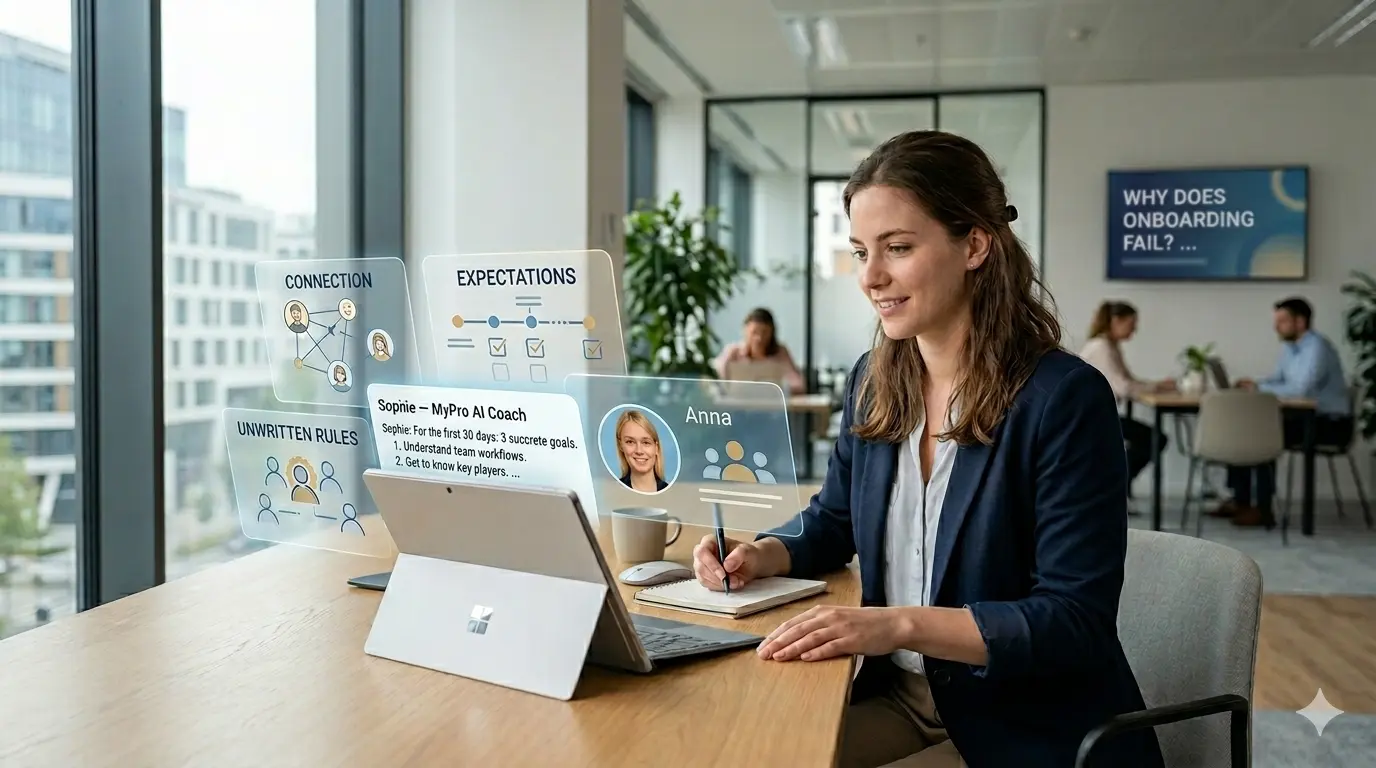
The numbers are hard to ignore. Research consistently shows that 88% of organizations onboard poorly. Not mediocrely. Poorly. The consequences play out fast, because 22% of new employees leave within the first 45 days when the onboarding process is weak. Failing to create a structured experience faces up to a 50% failure rate in retaining new hires altogether.
In Hungary, the picture is even starker. According to Ipsos and HRpwr research, only 38–40% of Hungarian employees have ever experienced a structured onboarding program. Among domestically owned SMEs — the backbone of the Hungarian business landscape — that figure drops even lower. This isn't a resource problem. It's a structural one.
What Actually Causes Onboarding to Fail?
Before looking at solutions, it's worth understanding where the real breakdowns happen. The data points to three recurring failure modes.
1. The Expectation Gap
The single most common reason new hires leave within the first 90 days isn't compensation. It isn't even culture. It's the gap between what they were led to believe the job would be — and what it actually is.
According to a 2025 Enboarder HR Leader Survey, 30% of early-stage leavers cite misalignment between job expectations and reality as their primary reason for leaving. This is rarely about dishonest hiring. It's about the fact that nobody systematically closes the gap between the offer and the first months on the job.
2. The Relationship Problem
New employees don't just need to understand their role. They need to understand the human landscape they've walked into.
Microsoft's WorkLab research found that whether someone stays or goes often has less to do with whether they know what to do — and more to do with how integrated they feel in the team's relationship network. The same research showed that assigning an "onboarding buddy" significantly improved both productivity and team connection, even in remote work settings. Lack of connection to the team or company culture is responsible for nearly 20% of first-90-day resignations.
3. The Checklist Trap
Most organizations treat onboarding as an administrative event. Sign the contract. Set up the laptop. Send the handbook. Done.
Research from the Human Capital Institute found that 58% of organizations focus their onboarding programs primarily on processes and paperwork, leaving the human, relational, and strategic elements completely unaddressed. The new employee spends their first weeks navigating bureaucracy while trying to read invisible cultural signals no one has explained to them.
The Part No One Fixes: The Manager's Knowledge Gap
Here's the problem that almost every onboarding framework ignores. The manager holds critical context about the new hire's role, the team dynamics, the unwritten rules, and the actual priorities, but almost none of it ever gets transferred in a structured way. It stays in their head because managers are busy, and there is no good mechanism to extract and use it.
The new employee gets a polished welcome email and a laptop, then spends their first month trying to guess what success actually looks like in this organization. This is the gap that AI coaching can address in a way that wasn't previously practical.
How Sophie Approaches Onboarding Differently
Sophie is one of the AI coaches in the MyPro AI Coach platform — a mentor-style thinking partner designed for ongoing, context-aware support. What makes Sophie's approach to onboarding distinct is where it starts: with the manager, before the new hire's first day.
Before onboarding begins, Sophie guides the manager through a structured reflection process, surfacing the things that usually stay unsaid. Not just job responsibilities, but the full picture of what actually matters.
- What does success look like in the first 30, 60, and 90 days, concretely?
- Who are the key relationships this person needs to build, and why?
- What are the unwritten rules of how this team operates?
- What's the biggest risk the manager sees in this hire, and what would resolve it?
- What did previous people in this role get wrong that this person should know about?
These aren't performance review questions. They are the questions a good mentor would ask, the kind that rarely get asked because no one has a structured reason to ask them.
Once that context exists, Sophie uses it throughout the new hire's onboarding journey. The new employee has access to a thinking partner who understands the specific context of their role, their team, and their organization's priorities.
What This Looks Like in Practice
The onboarding process Sophie supports isn't a one-time orientation. It's a structured introduction over weeks and months, the kind of sustained support that the research says actually works.
Brandon Hall Group found that organizations with a strong onboarding process improve new hire retention by 82% and productivity by over 70%. That kind of result requires consistent, structured support, a two-day welcome session is simply not enough.
Sophie provides a space where new employees can:
- Process what they're learning without burdening colleagues with every question
- Prepare for difficult early conversations with their manager, teammates, or clients
- Reflect on what's working and what's confusing, at their own pace
- Build confidence in their role before they're expected to perform fully in it
None of this requires an HR team to scale. The structure is already there.
The cost of failed onboarding is concrete. Replacing an employee typically costs between 16% and 20% of their annual salary, and that's before accounting for lost productivity, team disruption, and the time cost to managers and HR. For an SME, losing two or three new hires in the first quarter is a meaningful hit to the bottom line and to team morale.
The companies that retain new hires reliably aren't Western corporations investing massive amounts of money. They are simply investing more structure, and they are starting earlier, using the manager's knowledge instead of just the HR department's checklist. That's exactly what Sophie is designed to support.
Frequently Asked Questions
What is AI onboarding coaching?
AI onboarding coaching uses an AI assistant to guide new employees through their integration into a new organization. It provides structured support, a space for reflection, and context-aware guidance based on information provided by the hiring manager.
How does AI coaching help reduce employee turnover during onboarding?
It addresses the root causes of early-stage turnover, such as expectation gaps, lack of team connection, and insufficient ongoing support. AI coaching provides consistent, available, judgment-free support throughout the first 90 days, the period when most voluntary exits occur.
What information does MyPro AI Coach and Sophie use to support a new employee?
Sophie is guided by context provided by the manager before onboarding begins. This covers role expectations, team dynamics, cultural norms, and success criteria, allowing Sophie to provide relevant, personalized support rather than generic advice.
Is AI coaching a replacement for human managers or HR?
No, it is not a replacement. Sophie works alongside managers and HR teams, handling the ongoing support and reflective coaching that managers don't have time to provide consistently. This frees managers to focus on higher-value interactions rather than answering the same orientation questions repeatedly.
How long does onboarding take to be effective?
Research consistently shows that effective onboarding takes close to a year. Programs that end after two weeks leave new employees without support during some of their most critical adjustment periods. Sophie provides sustained, available support throughout this entire window.
MyPro AI Coach is an AI-powered coaching platform for professionals and organizations. Sophie is one of three AI coaches on the platform, designed for mentor-style, context-aware long-term support.
Next step
Try AI coaching — for free
MyPro AI Coach offers personalised, science-based coaching sessions — anytime, anywhere. The first 15 questions are free, registration required.